
Part 3: Training for Judgment, Not Certainty
Originally posted by Guro Denson, May 31st, 2026.
If combat is uncertain, chaotic, and context dependent, then an important question naturally follows:
What should martial arts training actually develop?
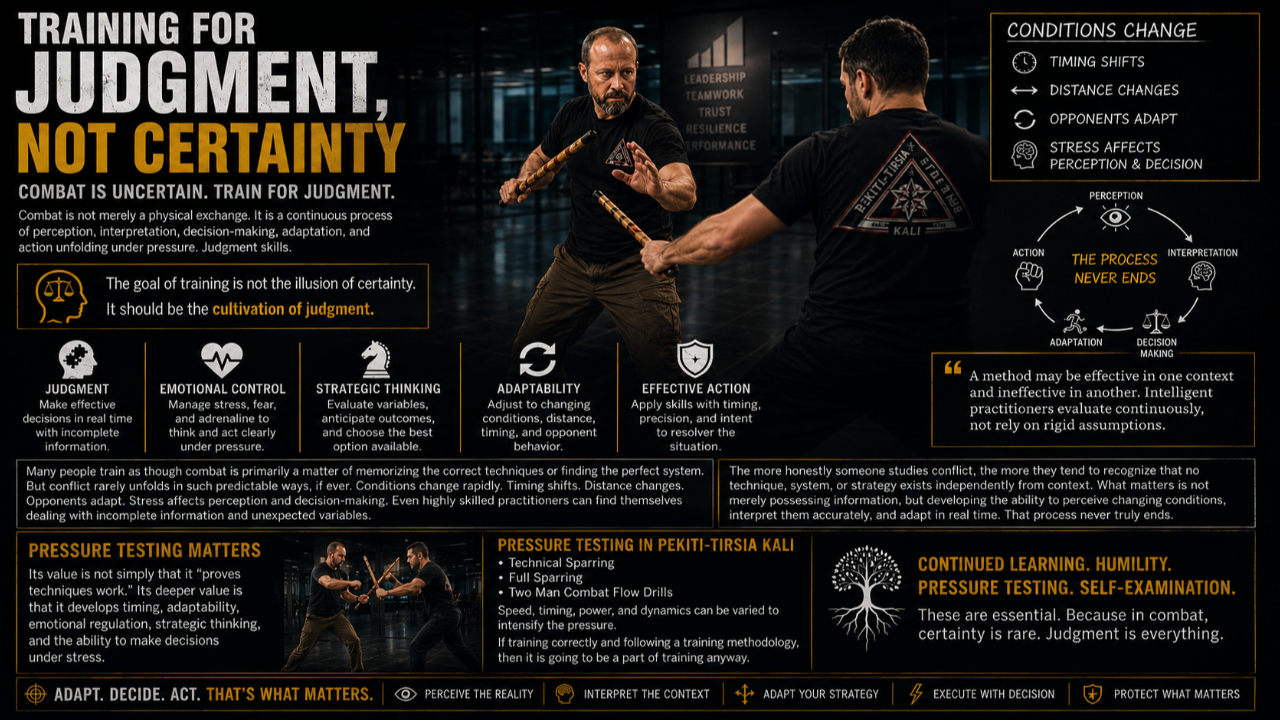
Many people train as though combat is primarily a matter of memorizing the correct techniques or finding the perfect system. But conflict rarely unfolds in such predictable ways, if ever. Conditions change rapidly. Timing shifts. Distance changes. Opponents adapt. Stress affects perception and decision-making. Even highly skilled practitioners can find themselves dealing with incomplete information and unexpected variables.
Under these conditions, the real issue is often not whether someone “knows techniques,” but whether they can make effective judgments in real time. One can memorize a technique, practice and repeat it many times, both solo and with a partner, and never execute it against a real attacker, because it is extremely unlikely that someone is going to attack you exactly as the technique is intended to counter. Techniques are also, usually defensive and meant to counter someone who has already attacked you as opposed to learning how to develop the awareness to proactively scan for potential threats.
Combat is not merely a physical exchange. It is a continuous process of perception, interpretation, decision-making, adaptation, and action unfolding under pressure. Judgment skills.
This is one reason pressure testing matters. Its value is not simply that it “proves techniques work.” Its deeper value is that it develops timing, adaptability, emotional regulation, strategic thinking, and the ability to make decisions under stress. It teaches people to function amidst uncertainty rather than pretend uncertainty does not exist.
Pressure testing itself may be a controversial topic within the combatives, martial arts, and self-defense world. Some believe it is an effective form of training and others do not. What does pressure testing look like in Pekiti-Tirsia Kali? If training correctly and following a training methodology, then it is going to be a part of training anyway. For example, pressure testing in PTK can be found in the technical and full sparring as well as the two man combat flow drills. Speed, timing, power, and dynamics can be varied with these drills to intensify the pressure.
A method may be effective in one context and ineffective in another. A tactically sound movement may become strategically inappropriate depending on terrain, timing, environment, weapons, legal considerations, or the behavior of the opponent. Intelligent, well-trained, and skilled practitioners learn to evaluate these variables continuously rather than relying on rigid assumptions or predetermined responses.
The goal of training, then, should not be the illusion of certainty.
It should be the cultivation of judgment.
The more honestly someone studies conflict, the more they tend to recognize that no technique, system, or strategy exists independently from context. What matters is not merely possessing information, but developing the ability to perceive changing conditions, interpret them accurately, and adapt in real time.
That process never truly ends. Which is why continued learning, humility, pressure testing, and honest self-examination remain essential parts of meaningful martial arts training.
Guro Denson
