
The Sword and the Mind: Proprioception, Physical Intelligence, and Martial Mastery
Originally posted by Dustin Denson, June 4th, 2026.
What is the best way to improve body awareness, balance, coordination, dexterity, and overall physical intelligence?
Physical intelligence is the ability to understand and manage how your body works in space. It affects how we move, think, feel, and behave. One of the most effective ways to develop physical intelligence is through the disciplined practice of martial arts such as Pekiti-Tirsia Kali.
At the heart of physical intelligence lies proprioception.
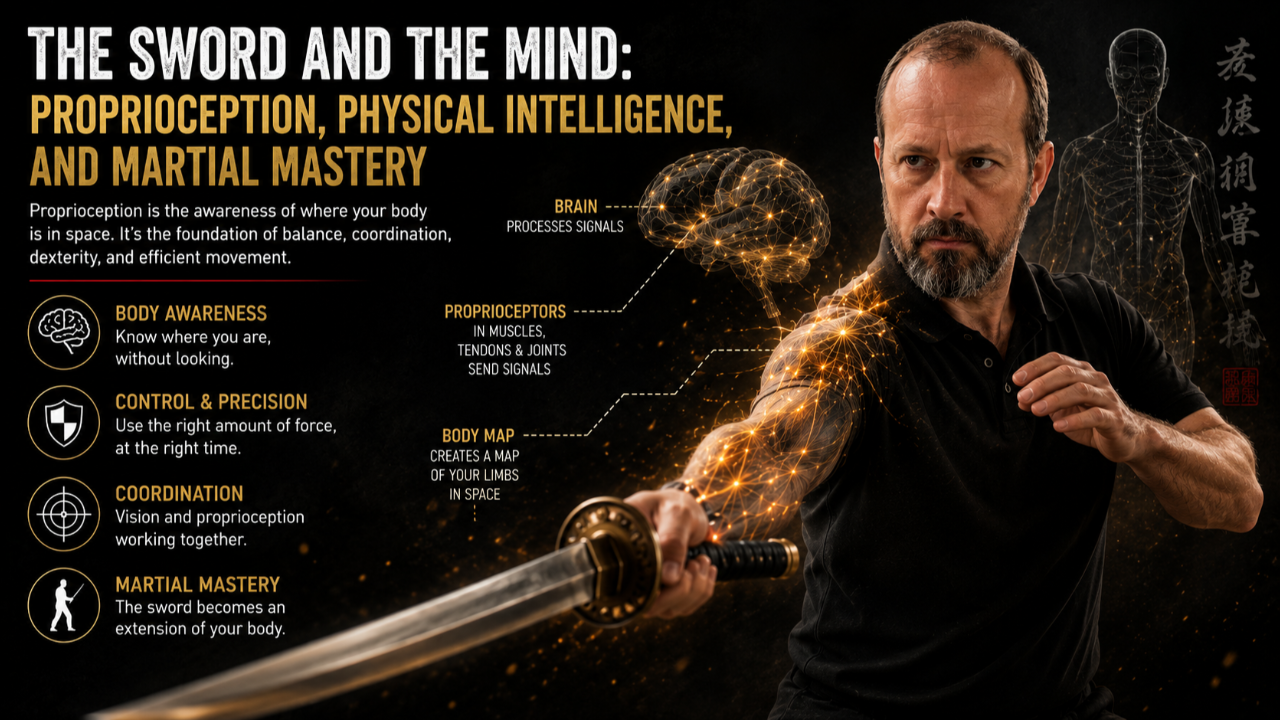
Proprioception is the awareness of where our body is in space. It is the subconscious sense that allows us to know where our limbs are, how they are moving, and how much force we are using without having to consciously think about it or constantly observe our movements with our eyes.
This process is made possible through proprioceptors—specialized sensory receptors located in the muscles, tendons, joints, and ligaments. These receptors continuously send signals to the brain. The brain processes this information to create what we might call a “body map,” allowing us to coordinate movement, maintain balance, and apply the appropriate amount of muscular force.
This is why we are able to perform ordinary actions such as lifting a cup of coffee to our lips without watching the cup the entire time. We instinctively know where our hand is in relation to our body and how to guide it accurately through space.
Proprioception also works together with vision to produce eye-hand coordination. Vision provides external reference while proprioception provides internal awareness. Together, they allow us to move efficiently and precisely.
We experience this often in daily life. For example, when threading a nut onto a bolt or turning a screw that is partially out of sight, we use our hands to “search” for the object while mentally visualizing its position. In a sense, we begin “seeing with our hands.” The brain creates internal visualizations through touch, movement, and spatial awareness.
Martial arts training develops this sense to a very high degree.
Through correct practice, martial arts such as Pekiti-Tirsia Kali improve balance, coordination, dexterity, timing, and body awareness. Repetition of mechanically sound movement patterns develops increasingly refined proprioceptive awareness of both the body and the weapon.
The sword is particularly valuable for developing this ability. Because of its length, weight, and extension away from the body, the sword trains the practitioner to perceive the weapon as part of the body rather than something separate from it. Over time, the practitioner develops a “body map” not only of the limbs, but also of the sword itself.
This development occurs through precise and attentive training. During forms, solo drills, partner drills, and sparring, the practitioner learns to attend carefully to different parts of the weapon—the tip, edge, spine, middle, or handle. Through repeated practice, proprioceptors detect the pressure, balance, movement, and shifting weight of the weapon in the hand and arm.
The brain gradually incorporates this information into its spatial map of the body. The sword begins to feel less like an external object and more like an extension of oneself.
Attention plays an important role in this process. Just as we can selectively attend to parts of our body, we can also attend to different parts of the sword in order to refine awareness and control. The more precise and mechanically correct the practice becomes, the more refined this proprioceptive sense develops.
This is why perfect or near-perfect repetition is so important in martial arts training. Incorrect repetition reinforces incorrect movement patterns, while precise repetition refines coordination, timing, efficiency, and control.
The development of proprioception through sword training transfers to other weapons categories as well. Because the sword provides an ideal balance of length, weight, leverage, and extension from the body, it becomes one of the best tools for cultivating advanced physical awareness.
Solo training plays a foundational role in this process.
Through solo practice, practitioners develop awareness of where their body and weapon are in space without needing conscious thought. Over time, movement patterns become internalized. This frees working memory and attention so that the practitioner can make real-time judgments regarding timing, distance, positioning, and tactical decisions during application.
Correct solo training maps the body and weapon into the nervous system through repetition. The practitioner no longer has to consciously think about every movement because the movement has become embodied.
However, solo training alone is not enough.
Combat drills, technical sparring, and full sparring are all necessary components in the development of mastery. Solo practice develops movement and proprioception. Partner drills refine timing and coordination with another person. Sparring develops adaptability, judgment, and application under pressure.
Together, these methods create a complete training process through which the practitioner develops true control of both body and weapon.
Ultimately, the goal is not merely to manipulate a sword skillfully, but to integrate the weapon into one’s physical awareness so completely that movement becomes natural, efficient, and instinctive. The sword ceases to feel separate from the body and instead becomes an extension of it.
Guro Denson
